¡Bienvenidos! Welcome! 歡迎 Welkom! ようこそ Willkommen! Dobrodošli! ברוכים הבאים Bem-vindo! आपका स्वागत है Witamy! Добро пожаловать! 환영 Bienvenue! ยินดีต้อนรับ Selamat Datang! Bine ati venit! أهلا وسهلا

lunes, 21 de febrero de 2011

Nace la Academia de Alejandría - The Academy of Alexandria is born

Estimados colegas:

El Foro de Alejandría nació con la vocación de compartir conocimiento y entusiasmo por nuestro quehacer implantológico. Quiero destacar, como editor de la página, la enorme generosidad del Dr. Joaquín García Rodríguez, creador de la técnica ESBIPRO, por habernos dedicado su tiempo y su saber con comentarios, consejos y casos clínicos. ¡Muchas gracias, Joaquín!

La única condición para la continuidad del Foro era que los lectores correspondiesen haciéndose miembros, aportando también sus comentarios, experiencias y casos clínicos. Pero tras 4 meses de andadura hemos tenido un gran éxito en número de visitas (más de 10.000, procedentes de múltiples países), pero con una respuesta decepcionante en cuanto colaboración con entradas y comentarios. Esperábamos que los visitantes de la página pusiesen su granito de arena en el proyecto, pero no ha sido así.

El Foro de Alejandría, por este motivo, tiene que cambiar. Van a desaparecer las entradas dedicadas a casos clínicos y de estudio, conservando el resto. De ahora en adelante, su misión será dar a conocer la técnica ESBIPRO y los cursos de Alejandría.

Hemos decidido crear una nueva página, la Academia de Alejandría, donde seguiremos publicando y comentando en privado nuestros casos cínicos, aconsejados por el Dr. García Rodríguez. El acceso a la Academia será restringido: estará reservado sólo a aquellos que sinceramente quieran aportar su experiencia, colaborar, aprender y enseñar.

Si alguno de los lectores del Foro está interesado en participar activamente y desea formar parte de la Academia de Alejandría, puede enviar su solicitud a : alvarobastida@live.com

Gracias a todos y un cordial saludo.

Dr. Álvaro Bastida
Dr. Juan Navas
Dr. Unai Guerrero
Dr. Joaquín García

 
Estimated colleagues:

 The Forum of Alexandria was born with the vocation of sharing knowledge and enthusiasm for our daily occupation, to put implants. I want to emphasize, as publisher of the page, the enormous generosity of the Dr. Joaquín García Rodríguez, creator of the ESBIPRO technique, for having devoted ourselves his time and his knowledge with comments, advices and clinical cases. Thank you very much, Joaquín!

The only condition for the continuity of the Forum was that the readers were corresponding becoming members, contributing also with his comments, experiences and clinical cases. But after 4 months of gait we have had a great success in number of visits (more than 10.000, proceeding from a lot countries), but with a disappointing response in collaboration with income and comments. We were hoping that the visitors of the page were putting his grain of sand in the project, but it has not been like that.

 That’s why the Forum of Alexandria must change. The income dedicated to clinical cases and of study are going to be eliminated, preserving the rest. From now on, his mission will be to announce and spread the technology ESBIPRO and the courses of Alexandria.


 We have decided to create a new page, the Academy of Alexandria, where we will continue publishing and commenting privately on our clinical cases advised by the Dr. García Rodríguez. The access to the Academy will be restricted: it will be reserved only to those that sincerely want to contribute his experience, to collaborate, to learn and to teach.

 If someone of the readers of the Forum is interested in taking part actively and wants to form a part of the Academy of Alexandria, they can send his request to: alvarobastida@live.com

 Thanks to all and a cordial greeting.

Dr. Álvaro Bastida
Dr. Juan Navas
Dr. Unai Guerrero
Dr. Joaquín García

miércoles, 9 de febrero de 2011

viernes, 4 de febrero de 2011

Challenges - Retos

Implantologic Challenges

by Dr. Joaquín García  Rodriguez

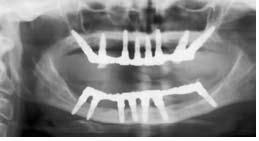
The next group of X Ray show several oral rehabilitation cases by ESBIPRO technique. They are difficult cases.

In simple words, the ESBIPRO technique has two objectives: to make the bone grow and to make the most of all the available bone.

This technique has 3 basic principles: 
  • Periosteum Preservation: Limited or partial flaps
  • Bone Preservation: Bone condensing and, on narrow ridges, bone expansion by longitudinal osteotomy and Microdent threaded expanders. These tools "put the destiny in your hands" as the surgeon feels the touch of bone strength at all times.
  • Controlled Local Anesthesia: We avoid anesthetizing the inferior alveolar nerve. In this way, we can evaluate the proximity between the osteotomy instruments and nerve structures.
The MV and MRT Microdent dental implants, with expansive core, were specially designed to combine with threaded expanders. They are useful in narrow bone ridges. With the ESBIPRO technique and expansive core implants, we can overcome two implantologic challenges:
  • Inferior Alveolar Nerve Lateralization: We can insert dental implants in cases of low mandibular bone height,  so that they pass next to the nerve without touching it. This is achieved by controlled anesthesia. No postoperative paresthesias and dysesthesias, very common in alternative techniques such as Inferior Alveolar Nerve Transposition.
  • Maxillar Bone Buttresses Location: We can insert implants in an atrophic maxillar, making the most of all the remaining bone volume, without bone graft material. Threaded expanders provide us feel-touch and we can place implants looking anatomical buttresses
It´s possible. You only have tu do!

[See also "Técnica ESBIPRO" and "Actualización conceptos ESBIPRO"]

Microdent Threaded Expanders - Expansores roscados Microdent
 ------------------------------------------------------------------------------------------------------------

Retos implantológicos

por Dr. Joaquín García Rodríguez

En el siguiente grupo de ortopantomografías se muestra la rehabilitación mediante la técnica ESBIPRO de varios casos de especial dificultad, por la gran atrofia ósea.

En términos sencillos, podemos decir que  la técnica ESBIPRO está encaminada a dos objetivos: hacer que el hueso crezca y aprovechar todo el caudal óseo disponible. Para ello, se fundamenta en 3 pilares:
  • Preservación del periostio: Despegamientos limitados o parciales. 
  • Preservación del hueso: Condensación ósea y, en crestas estrechas, expansión ósea mediante osteotomía longitudinal generosa y uso de expansores roscados Microdent. Estos instrumentos "ponen el destino en tus manos", ya que permiten en todo momento el tacto del cirujano con la resistencia ósea, sin mecanismos intermedios. 
  • Anestesia local controlada: Se evita anestesiar el nervio dentario inferior y el mentoniano. Así se puede evaluar intra-operatoriamente la proximidad de las estructuras nerviosas a los instrumentos de osteotomía.
 En casos de crestas ósea tróficas resultan extremadamente útiles los implantes de la marca Microdent MV (conexión externa) y MRT (pilar integrado), de núcleo expansivo, diseñados especialmente para ser usados en combinación con los expansores roscados. Con la técnica ESBIPRO y los implantes de núcleo expansivo es posible superar dos retos implantológicos:
  • Lateralización del nervio dentario inferior o el bucle mentoniano: En casos de poca altura ósea mandibular, se puede insertar el implante de tal forma que pase al lado del dentario o el bucle sin tocarlos. Ello es posible gracias a la anestesia controlada. No hay parestesias y disestesias postoperatorias, muy frecuentes en técnicas alternativas, como la transposición del dentario inferior.
  • Localización de arbotantes óseos del maxilar superior: En un maxilar atrófico, podemos insertar implantes aprovechando el caudal óseo remanente, sin necesidad de tener que recurrir a injertos. Merced al tacto que nos brindan los expansores roscados, podemos colocar implantes buscando los arbotantes anatómicos.
Es posible. Sólo tienes que hacerlo.

[Ver también"Técnica ESBIPRO" y "Actualización conceptos ESBIPRO"]
Figura 1. Rehabilitación del Maxilar inferior con mesoestructura fija, previa lateralización de dentario y del búcle mentoniano.

Figura 2. Rehabilitación ceramometalica inferior con lateralización de los bucles mentonianos e inserción de fijaciones MRT de carga inmediata Microdent System. En este tipo de implantes monofásico se puede realizar una conexión protésica atornillada o cementada.

Figura 3. Rehabilitación ceramometalica con lateralización de nervio dentario y del bucle mentoniano. Inserción de implantes MRT para carga inmediata, este tipo de fijación es para realizar prótesis cementada, es monofásico y el muñón se puede tallar.

Figura 4. Rehabilitación de extremos libre mandibular, con lateralización de los bucles mentonianos. Inserción de fijaciones MV de núcleo expansivo.

Figura 5. Rehabilitación de ambos maxilares con mesoestructuras fijas. En el maxilar superior, abordaje de los arbotantes pterigoides y caninos con implantes de nucleo expansivo de 5 mm de diámetro MV. Maxilar inferior con lateralización del nervio dentario e inserción de fijaciones MV 3,75 mm de Microdent.
[Editado y traducido por Dr. Álvaro Bastida]